How to set up a backyard badminton game in a small space
· Editorial team newswithryanchicago.com
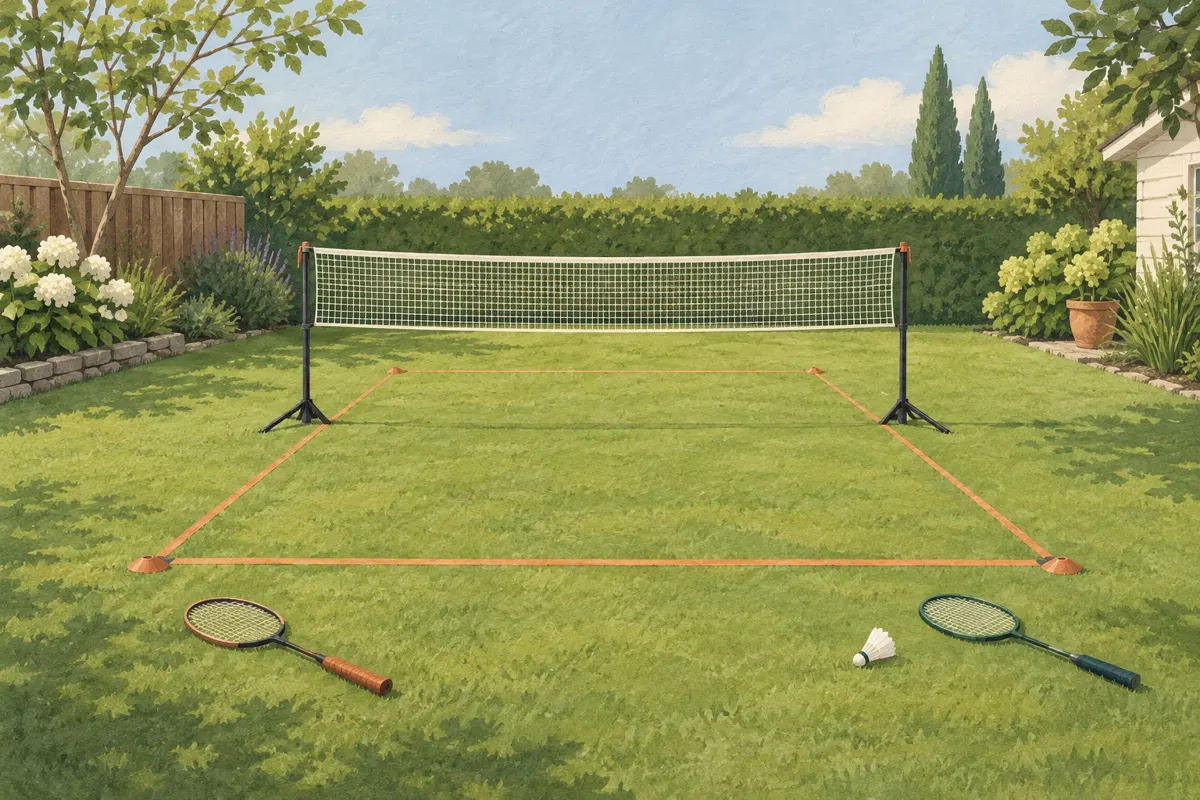
Set up backyard badminton by choosing a clear, level area, dividing it into two equal halves and marking boundaries that leave room to move safely. Start with one player on each side and gentle shots. The smaller layout and house rules below are editorial proposals for casual play; adjust them to fit your yard and the people playing.
Choose the area before setting up the net
Look for a patch where both players can step sideways and backward without reaching a fence, garden bed or piece of furniture. Check overhead space, too: branches, clotheslines and patio structures can interrupt a swing or catch a shuttlecock. Choose the playing area around the available clearance rather than stretching it to fill the entire yard.
- Remove toys, hoses, loose sticks and other objects from the playing area.
- Check the surface for holes, exposed roots, slippery patches and uneven edges.
- Leave clear space outside the proposed boundaries so players can stop without meeting an obstacle.
- With everyone else standing clear, have each player slowly rehearse a swing and a few steps in each direction.
If a player cannot swing comfortably or move without approaching an obstacle, shrink or reposition the layout. Keep spectators and waiting players outside the swing area. A shuttle heading toward a fence or planting bed can be left to land.
Mark boundaries that suit your yard
Badminton uses a playing area divided into two halves, with one player per side in singles or two per side in doubles. For a small backyard, our proposed adaptation is a compact rectangle with equal halves and one player on each side. Keep the shape easy to recognize so players can judge where a shuttle lands.
Use visible, flat markers suitable for the surface. Avoid raised objects in places where feet will land. Mark the corners, sidelines and back boundaries, then agree whether a shuttle touching a boundary counts as in. Our proposal is to count it as in and replay any landing neither player could see clearly.
Try several gentle exchanges before settling on the boundaries. If ordinary returns repeatedly send someone toward an obstacle, move that boundary inward. If the rectangle is too cramped for comfortable movement, switch to the cooperative game described below.
Keep equipment and net placement simple
The basic playing equipment is a badminton racket for each player and a shuttlecock. Choose rackets that players can hold and swing comfortably, along with clothing that allows movement and supportive sports shoes. The supplied sources also suggest lighter rackets for beginners and younger players.
Place a portable net across the middle of your marked area and follow its setup instructions. Keep poles, bases and any anchoring cords outside the space players use to move. Check that the setup is stable before starting, and keep spare rackets and shuttlecocks off the playing surface.
If the net supports leave too little room, our proposed alternative is a cooperative rally without a net. Face each other across a clear gap and exchange gentle shots. Avoid improvising a thin cord across the yard where someone could walk into it.
Agree on a few small-space house rules
Decide how to serve, score and handle interruptions before the first rally. These proposed house rules keep a casual game manageable in a compact yard; they are adaptations for your setup.
- Begin each rally with a gentle underhand serve toward the other player.
- Award a point when the shuttle lands inside the opponent’s area or the opponent sends it out.
- Play to an agreed target, such as seven points, then swap ends.
- Use controlled shots and leave hard smashes out of the game.
- Stop immediately if someone enters the playing area.
- Replay a disputed point or a rally interrupted by an obstacle.
For a mixed group, rotate players after each short game rather than squeezing four people into the same small rectangle. Before resuming, make sure the departing player has cleared the area.
Use a cooperative game when space is tight
Our proposal for the smallest usable area is to count consecutive returns together. Send the shuttle toward your partner at a comfortable height, reset the count when it drops and try to improve your shared total. This gives beginners a clear goal without encouraging shots into difficult corners.
Start slowly and adjust after the first few rallies. Move closer if returns consistently fall short, provided both players still have separate swing space. If wind keeps carrying the shuttle outside the area, pause and try again in calmer conditions. End or change the activity whenever comfortable movement and clear swings are no longer possible.